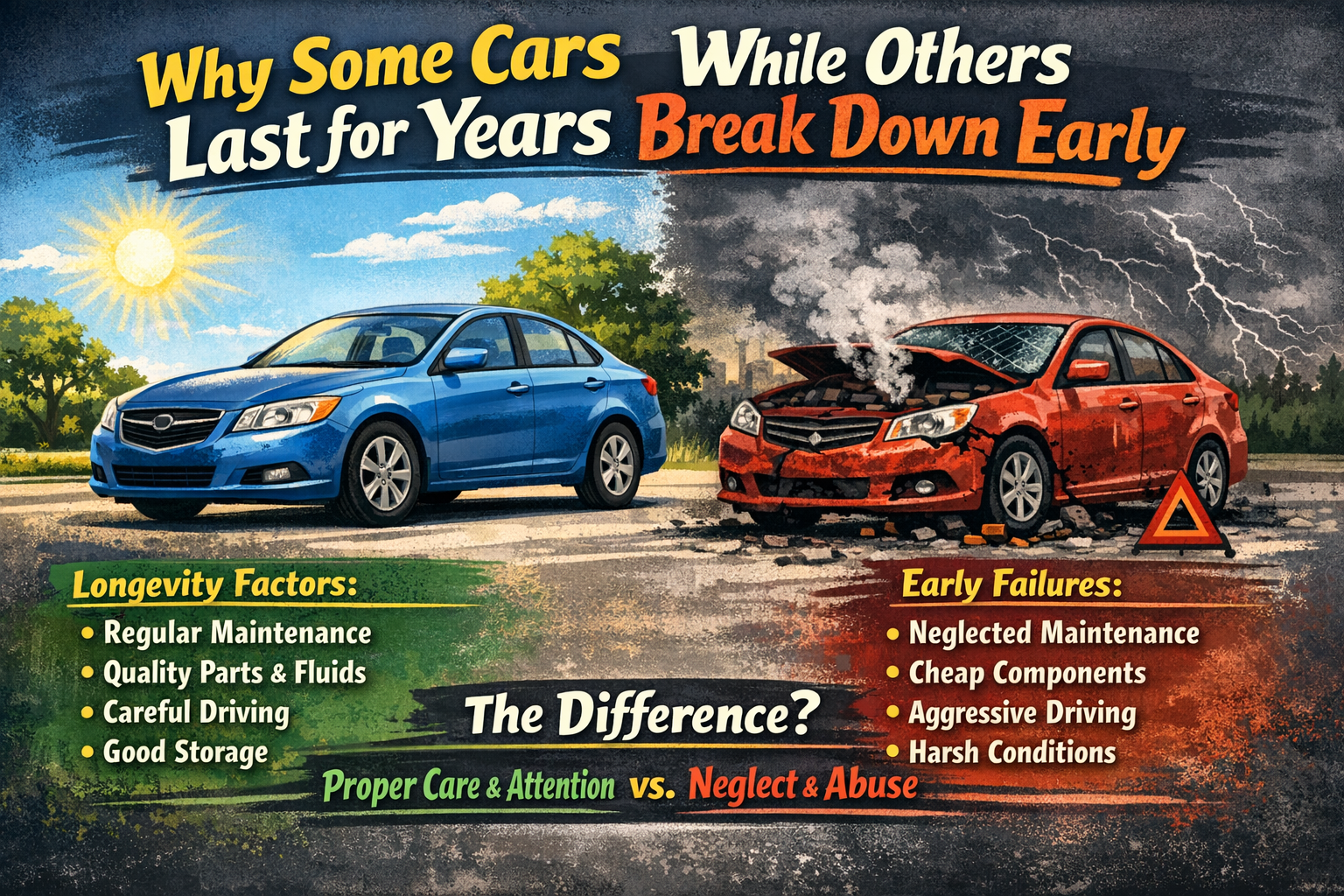
Spend enough time around cars and you start noticing a pattern. Two vehicles can leave the factory nearly identical, yet years later one feels solid and dependable while the other seems constantly on the edge of something breaking. That gap often comes down to why some cars last for years while others break down early, and it’s rarely just about luck.
It Begins Long Before Anything Breaks
Most people think durability shows up only when something fails. In reality, it starts much earlier — in how the car is treated when everything still feels new.
There’s a phase when nothing seems fragile. The engine is smooth, the brakes are sharp, every response feels immediate. That’s exactly when habits form.
Some drivers push the car hard right away, assuming it can handle anything. Others move more gradually, letting systems settle into use. Neither approach feels dramatic at the time, but over months the difference becomes real.
It’s not about being overly careful. It’s about how consistently the car is used in those early stages.
Stress Doesn’t Announce Itself
What shortens a car’s life isn’t always visible damage. It’s accumulated stress that never quite resets.
Think about everyday situations:
- short drives where the engine never fully warms up
- repeated heavy braking instead of anticipating traffic
- carrying unnecessary load without noticing the effect
None of these will cause immediate problems. But they create a kind of background strain that slowly builds.
The car doesn’t complain. It adjusts. And that adjustment often means parts working just a bit harder than they should, for longer than expected.
Maintenance Is Only Part of the Story
It’s easy to assume that regular maintenance is the main dividing line. It matters, of course — skipping it accelerates problems.
But even with the same maintenance schedule, cars can age differently.
One feels tight and predictable. The other develops small inconsistencies — nothing critical, just enough to make driving less smooth.
That’s where usage fills the gap. Maintenance keeps things functioning. Habits decide how much strain builds between those checkups.
You can service a car perfectly and still wear it down faster than expected.
Small Signals People Ignore
Cars rarely fail without warning. The signs just aren’t dramatic enough to trigger concern.
A slight delay in response. A new vibration that comes and goes. A sound that wasn’t there before but doesn’t seem serious.
Most drivers adapt instead of questioning it.
And that’s where why some cars last for years while others break down early becomes clear — not in big failures, but in how long those small signals are ignored.
Closing Thought
Longevity isn’t a single decision. It’s the result of hundreds of small ones that never felt important in the moment.
Some cars last because they’re driven in a way that reduces stress without trying too hard. Others wear down faster simply because no one noticed the patterns forming.
Over time, the difference becomes visible — not suddenly, but gradually, until it’s impossible to miss.