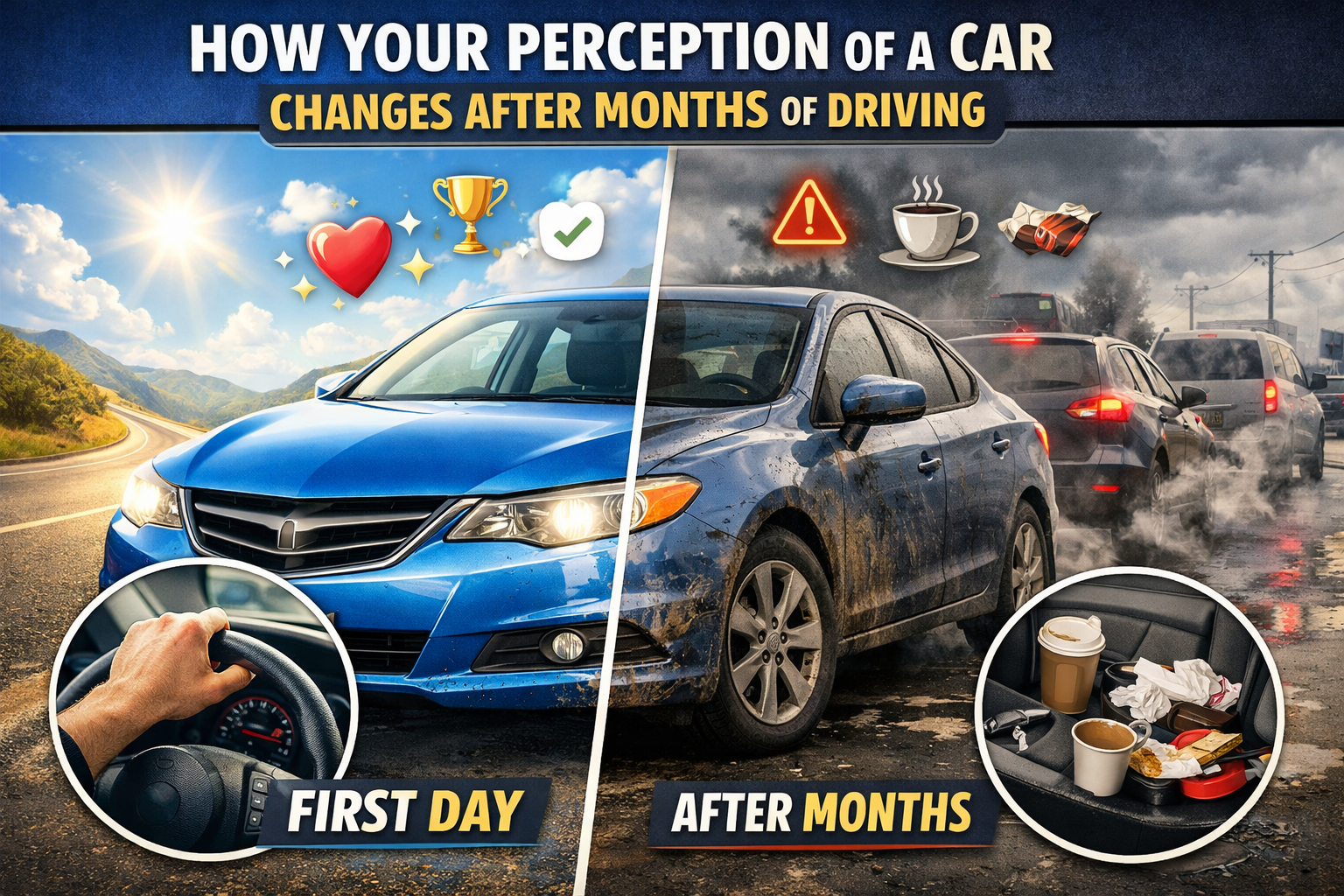
At first, everything about a car stands out — the smell, the response, even the way the doors close. But after a few months, something shifts, and how your perception of a car changes after months of driving becomes less about excitement and more about how it fits into your everyday rhythm.
The Things You Stop Noticing First
In the beginning, you pay attention to details you normally wouldn’t. The smoothness of acceleration, the quiet cabin, how precise the steering feels. It’s almost like you’re testing the car constantly, even without realizing it.
Then, gradually, those impressions fade into the background.
What stays isn’t the initial “wow” factor, but the things that quietly support your routine. You stop thinking about how good the ride feels — unless something starts to feel off. Comfort becomes invisible when it works.
And that’s the first shift. The car stops being something you evaluate and becomes something you rely on.
When Small Details Start to Matter More
After a while, different things begin to stand out — often ones that didn’t seem important at the start.
You notice how the seat feels after a longer drive, not just for ten minutes. You pay attention to how easy it is to park in tight spaces. You remember how the car behaves in traffic, not on an open road.
It’s not dramatic, but it changes your priorities.
What seemed minor at first starts to define the experience:
- how quickly the cabin warms up on a cold morning
- whether visibility feels natural or slightly awkward
- how intuitive the controls actually are when you’re tired
These aren’t features you think about when choosing a car. But over time, they shape how you feel about it.
The Gap Between Expectation and Reality
There’s always a point where expectations meet real use. And they don’t always align.
Some cars grow on you. Others slowly lose their appeal.
A vehicle that felt exciting at the beginning might start to feel tiring in everyday conditions. Not because it changed — but because your context did. Daily driving exposes patterns that short test drives never reveal.
It often comes down to this quiet realization: what impressed you isn’t always what you needed.
That’s where how your perception of a car changes after months of driving becomes more personal. It’s less about the car itself and more about how it fits into your life.
You Start Driving Differently Without Noticing
Over time, your behavior adapts to the car.
You take turns a certain way because it feels more natural. You adjust your speed based on how the car responds. Even your posture changes slightly, shaped by the seat, the wheel, the visibility.
It happens gradually, almost invisibly.
And once that adaptation settles in, the car feels “normal.” Not because it’s perfect, but because you’ve adjusted to it. That’s why switching to another car after months can feel strange, even if it’s objectively better.
It Becomes Less About the Car
Eventually, something else happens.
You stop thinking about the car as a separate thing. It blends into your routine — part of your day rather than an object you notice. You don’t evaluate it constantly anymore.
Instead, you only notice it when something interrupts that flow.
That shift is subtle but important. It marks the moment when the car either fully fits your life… or quietly starts to annoy you in ways that are hard to explain.
Closing Thought
Looking back, the first impression rarely tells the full story. What matters shows up later, in small, repeated moments that build over time.
And that’s really what defines how your perception of a car changes after months of driving — not the features you remember from day one, but the feeling you’re left with when the car becomes part of your everyday life.