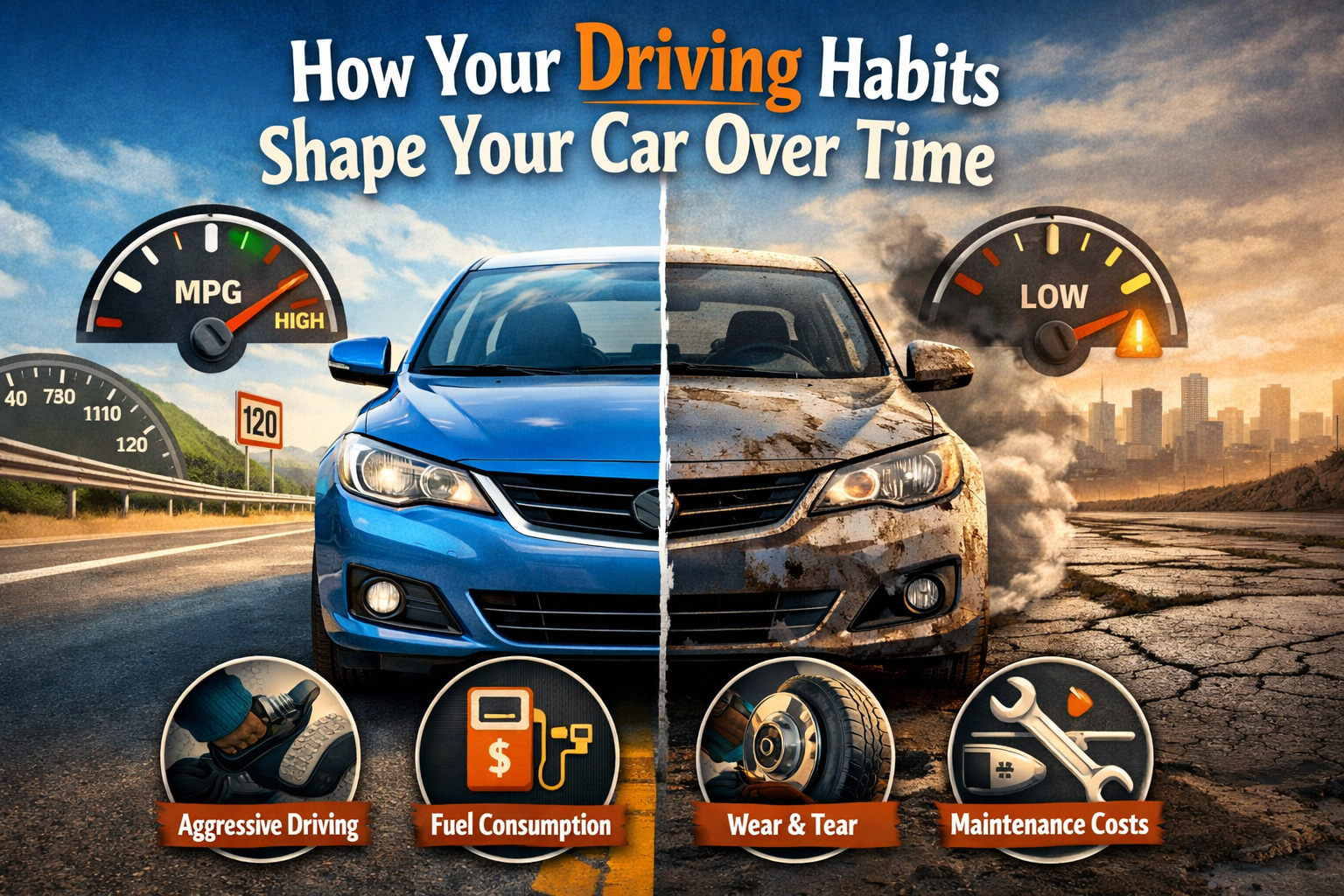
It doesn’t take long to notice that how your driving habits shape your car over time isn’t just theory — it becomes visible in small, quiet ways. At first everything feels the same, but months later the car starts to “behave” differently, almost like it adapted to you.
It Starts With Subtle Patterns
At the beginning, most people focus on obvious things: speed, fuel, maybe comfort. But the real influence builds in repetition.
A car remembers patterns, not moments.
If acceleration is always sharp, the response becomes a bit more aggressive. If movements are smoother, the car settles into that rhythm instead. It’s not that the machine changes its design — but its wear, its reactions, even its sound begin to shift slightly.
You don’t notice it day by day. Then one day you drive someone else’s car and realize yours feels… different.
Wear Doesn’t Happen Evenly
There’s a tendency to think of wear as something uniform, like everything ages at the same pace. That’s not how it works.
Some parts carry the consequences of habits more than others. And they don’t complain right away.
Think about it in simple terms:
- frequent hard braking puts stress where you don’t see it immediately
- short trips never let systems fully stabilize
- constant stop-and-go creates uneven load instead of steady use
None of this breaks the car overnight. It just creates a slightly different version of the same vehicle.
The Feeling Changes Before the Problem Appears
What’s interesting is that the car usually signals change long before anything actually fails.
It’s not a warning light. It’s more like a shift in character.
The steering might feel a bit less precise. The engine sound might become slightly rougher in certain moments. Even the way the car reacts to familiar roads can feel off, but not enough to clearly explain why.
Most people ignore this stage because nothing is technically wrong yet.
That’s exactly the point where how your driving habits shape your car over time becomes noticeable — not through failure, but through feel.
Different Drivers, Different Outcomes
Give the same car to two people for a year, and you’ll get two different results. Not dramatically different, but enough to notice.
One car might feel tighter, more predictable. The other — slightly worn, less responsive, even if both are “in good condition.”
It often comes down to consistency.
Some drivers unintentionally create stress through small, repeated actions. Others reduce it without thinking about it, simply by being smoother or more attentive.
There’s no single “correct” style, but there is a clear difference in outcome.
Closing Thought
A car doesn’t just reflect its mileage. It reflects behavior.
Over time, it becomes a quiet record of how it was used — not in big decisions, but in hundreds of small ones that felt insignificant in the moment.
That’s why how your driving habits shape your car over time is less about mechanics and more about patterns you don’t notice while they’re forming.